- Unit 20/21 Warrington Market, WA1 2NT
- 01925 344 007
Finding the right contact lenses is about more than simply matching a prescription to a lens.
At Edge Eyewear, we take time to understand how you want to use your lenses, what you need from them and how they perform in everyday life. Our approach is particularly thorough because our optometrist also teaches contact lenses at the University of Manchester, bringing extensive knowledge and experience to contact lens fitting.
In our experience, many people are wearing contact lenses that are not necessarily the best match for their needs. We take a different approach by considering the individual rather than assuming that one lens type or manufacturer will suit everyone.
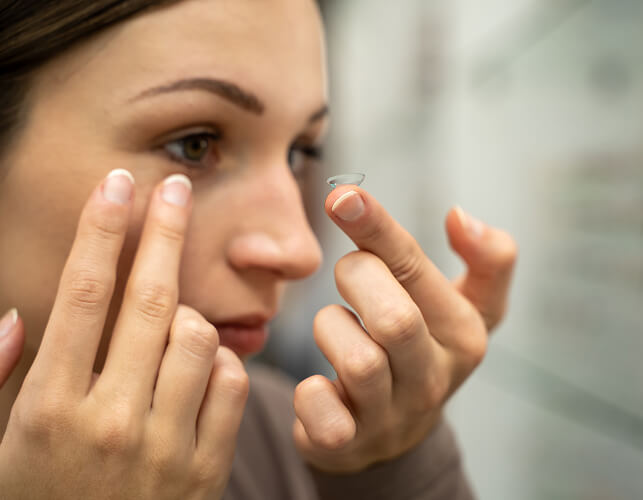
There are many different contact lenses available, and the most suitable option will depend on your prescription, your eyes, your lifestyle and how you want to wear your lenses.
We can help patients who are new to contact lenses as well as existing wearers who are not completely happy with their current lenses. This can include people who have previously struggled with comfort, vision or handling their lenses.
We can also consider more complex requirements, including astigmatism and multifocal contact lenses, where choosing the right lens can make a significant difference to the overall experience.
A proper contact lens fitting involves assessing the health of the eyes, considering your individual requirements and making sure the lenses are appropriate for you. The College of Optometrists recommends considering factors such as ocular and medical history, occupational and recreational needs and the environments in which lenses will be worn when deciding on the most appropriate lenses.
There is no single contact lens manufacturer or lens type that is best for everyone.
Rather than automatically reaching for the same lens, we may give you different options to try. This gives you the opportunity to experience how different lenses feel and perform outside the consulting room.
That matters because a lens can seem perfectly comfortable when you are sitting in an examination room but feel very different after several hours of wear at work, while exercising or going about your normal day.
Your experience in the real world gives us useful information when deciding which lens is the best fit for you.


For someone who has never worn contact lenses before, learning to apply and remove them can seem like the hardest part.
We don’t rush this.
If it takes time to learn how to put your lenses in and take them out, that’s fine. If you need to come back another day and try again, that’s fine too.
We demonstrate the process carefully and will also demonstrate applying and removing lenses ourselves, so you can see exactly what is involved before trying it yourself.
The aim is not simply to put a lens on your eye. You need to feel confident handling your lenses safely and hygienically before you start wearing them regularly. This is an important part of professional contact lens fitting and aftercare.
Getting the initial fit right is only part of the process.
We provide ongoing aftercare and can arrange as many appointments as are needed while you are getting used to your lenses or if we need to make changes to the fit.
Regular contact lens check-ups are important because your eyes need to remain healthy while you are wearing lenses. The appropriate frequency of these checks depends on your individual circumstances, the type of lenses you wear and how you wear them.
If something does not feel right, don’t simply put up with it. Discomfort, redness, watering or changes in vision should be discussed with your contact lens practitioner.


The right contact lenses should work for the way you actually live.
We can consider factors such as:
The fitting process should be about finding a practical solution that works for you, rather than simply selecting a lens from a catalogue.
Our approach is based on knowledge, experience and time.
Teaching contact lenses at the University of Manchester means our optometrist has a particular interest in this area of optometry. More importantly, that knowledge is applied to the individual patient sitting in front of us.
If you have never worn contact lenses, have struggled with lenses in the past, or simply wonder whether there is a better option available to you, we are happy to take the time to find out.

Yes. There are contact lenses specifically designed to correct astigmatism. Your eyes and prescription will need to be assessed to determine which type is appropriate for you.
Multifocal contact lenses can be an option for people who need correction for both distance and near vision. Finding the right lens can take some trial and refinement, which is why individual fitting and follow-up are important.
It is worth having another assessment. Different lenses can feel and perform very differently, and your previous experience does not necessarily mean that contact lenses are unsuitable for you.
There is no need to rush. We will show you how to apply and remove your lenses and give you time to practise. If you need another appointment to continue learning, we are happy to arrange one.
Where appropriate, we may provide different lens options for you to experience. Seeing how a lens performs in your normal day-to-day environment can be more informative than simply wearing it for a short period in the consulting room.
Yes. Contact lens wearers should have regular checks to monitor the health of their eyes and make sure their lenses remain suitable. The frequency depends on your individual circumstances and the type and pattern of lens wear.
You will be given specific advice about wearing, cleaning, storing and replacing your lenses. Good hygiene is essential, including washing and drying your hands before handling lenses and following the care system recommended for you.