- Unit 20/21 Warrington Market, WA1 2NT
- 01925 344 007
An eye examination should be about much more than finding out whether you need a stronger pair of glasses.
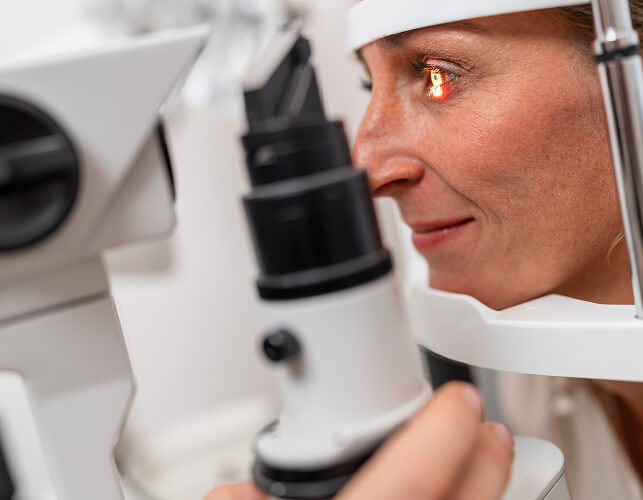
At EDGE Eyewear, your eye examination is a thorough assessment of your vision and eye health, carried out personally by Graham, our optometrist and practice owner. From checking your eye pressure and taking retinal photographs to performing OCT scans and assessing your prescription, Graham carries out the examination himself.
We believe the person best qualified to examine your eyes should be the person doing the examination.
And, importantly, you will see the same optometrist every time you visit us.
Time is one of the biggest differences between an eye examination at EDGE Eyewear and a typical high-street experience.
Our standard eye examinations are 45 minutes, giving Graham the time to assess your eyes properly, talk through what he finds and answer your questions without feeling under pressure to move on to the next appointment.
If we feel your examination needs longer, we will extend the appointment at no additional cost.
And if there is a genuine reason why everything cannot be completed properly during your appointment, we will arrange for you to come back. Again, there is no additional charge.
We would rather give you the time you need than rush an important health check.
When you book an eye examination at EDGE Eyewear, you know who will be examining your eyes.
Graham is our optometrist and director. He has more than 30 years of experience in optics and has taught optometry at The University of Manchester for more than 10 years.
There is no first part of the examination carried out by shop floor staff before you see the optometrist. From start to finish, your examination is with Graham.
For us, that continuity matters.
Your appointment will be tailored to you, but a comprehensive eye examination will normally involve several different assessments.

We will begin by talking about your vision, any symptoms or concerns you have and your general health. We may also ask about your family history and any medication you take, as these can be relevant to your eye health.
If you have noticed a change in your vision, even if it seems minor, this is the time to tell us.

We assess how clearly you can see at different distances and determine whether you need a prescription for glasses or contact lenses.
This is an important part of your examination, but it is only one part.

We measure the pressure inside your eyes as part of our assessment.
Eye pressure is one of several factors that can be relevant when assessing the risk of glaucoma. It is important to understand that eye pressure alone does not diagnose glaucoma, which is why it forms part of a wider eye health assessment.

We examine the structures at the front and back of your eyes to look for signs of eye disease or other abnormalities.
Regular eye examinations can help identify conditions such as glaucoma, cataracts and macular degeneration, sometimes before you notice any symptoms.

Detailed photographs of the back of your eyes provide a record of your retinal health and can help us identify changes that may need further investigation.
Having these images also gives us a useful reference for future examinations, allowing us to monitor changes over time.

We use OCT, or optical coherence tomography, to create detailed cross-sectional images of the retina.
Unlike a standard retinal photograph, which gives us a surface view, OCT allows us to examine the different layers of the retina in much greater detail. This can be particularly useful when assessing conditions affecting the macula, optic nerve and other structures at the back of the eye.
If we have a particular concern, we can take additional scans and spend more time investigating the area.

Your prescription is important, but your eyes are part of your overall health.
An eye examination can help identify signs of eye conditions and other abnormalities, even when your vision appears normal. Optometrists are trained to examine the internal and external structures of the eye and identify conditions such as glaucoma and macular degeneration, referring you for further investigation when necessary.
That is why we take a comprehensive approach at EDGE Eyewear.
We are not simply looking for a change in prescription. We are assessing the health of your eyes, considering your individual circumstances and looking for anything that may need monitoring or further investigation.
There is something reassuring about knowing who will be examining your eyes.
At EDGE Eyewear, Graham is the only optometrist you will see for your eye examination. This means he gets to know you, your eyes and your history over time.
That continuity can be particularly valuable when monitoring changes in your eye health. Rather than starting from scratch at every appointment, we can look at previous results, images and scans alongside your current examination.
It also means you can build a relationship with the person responsible for your eye care.


We use modern diagnostic technology because it gives us more information about your eyes.
But technology is only useful when it is combined with clinical experience and careful interpretation.
Our equipment includes OCT retinal scanning, retinal photography and eye pressure measurement. These assessments give Graham detailed information about the health of your eyes, helping him identify changes and decide when further investigation or referral may be appropriate.
The important part is what happens next.
We take the time to explain what we have found in straightforward language, so you understand your results rather than simply being given a prescription.
Our standard appointment is already longer than many routine eye examinations. However, we do not believe in watching the clock if there is a clinical reason to spend more time with you.
If something needs further investigation, we can extend your appointment without an additional charge.
If there is not enough time to complete everything properly, we will arrange another appointment and bring you back without charging you again.
That is simply how we think eye examinations should be done.
There is no benefit in rushing an examination just to keep to a timetable.


Graham’s work extends beyond the consulting room. He has taught optometry at The University of Manchester for more than 10 years, sharing his experience with the next generation of optometrists.
He believes this benefits his patients as well as his students.
Teaching means continually reviewing your knowledge and techniques, keeping up with developments in optometry and being prepared to explain why things should be done in a particular way.
For patients, that means you benefit from an optometrist who remains actively engaged with the profession and committed to maintaining high standards of clinical care.
For most people, regular eye examinations are recommended every two years, although some people need to be examined more frequently depending on their age, eye health, prescription or individual risk factors.
You should not wait for your next routine appointment if you notice a significant change in your vision or develop new symptoms.
An eye examination is not just about checking whether you need glasses. It is an important opportunity to check the health of your eyes and identify potential problems at an early stage.
If your examination shows that you would benefit from glasses or contact lenses, we can talk you through the options.
Because your eye examination is carried out personally by Graham, any recommendations can be based on your individual prescription, visual needs, lifestyle and eye health.
There is no pressure to choose a particular product. Our role is to help you understand your options and find the solution that works for you.
According to mates of mine who like to belittle my skills and abilities, it’s just counting your eyes and getting you to read a few letters. “One, two. Correct number of eyes. Check! Now read those letters. All done. You can go”. Of course, my mates are idiots! An eye examination is actually a comprehensive assessment of your eye health and vision conducted by an optometrist (also known as an ophthalmic optician). It involves various tests and assessments to evaluate the condition of your eyes and determine any vision problems or eye diseases.
Regular eye examinations are essential to monitor your eye health, detect vision issues, and identify potential eye diseases (e.g., glaucoma, macular degeneration) at an early stage. They help ensure clear and comfortable vision and can even detect underlying health conditions like diabetes and high blood pressure. And this goes for everyone! Even if you don’t need glasses or contact lenses. Being able to see doesn’t necessarily mean your eyes are healthy. I can’t know if my eyes are healthy unless somebody checks them for me, and I’m a fully qualified optometrist (and frankly a damn good one too 😂).
Well that really depends on what your optometrist thinks. Generally speaking, a good rule of thumb is 2-years at the very most. Here at EDGE we often see patients every year. The reason for this? Well, back when I started in optics many years ago, your records were a few words scrawled on a piece of paper. One year later there wasn’t exactly a lot to compare against. Because we have the kind of equipment that is taking tens of thousands of measurements per second, there’s a lot more to compare to at that 1-year mark. Now that we can pick up very early warning signs of eye conditions much earlier than before, a yearly check is often what we decide upon.
You’ll have to book one and find out! Just kidding! I’ll tell you 😁. During an eye exam, your eye care professional will perform a series of tests including eye pressure measurement, examination of the health of the eyes, checking vision, checking for any prescription, and often many more checks besides as decided at the time. It’s safe to say that the time spent and comprehensiveness of an eye examination done at EDGE often comes as a surprise to new patients – even those who’ve had many eye examinations in the past.
No, the eye examination is typically painless. Some tests, such as pupil dilation, may cause minor discomfort or temporary mild blurriness. However, for most eye examinations this is not necessary. Anyway, any discomfort is mild and only lasts a few seconds.
Now that really depends on where you go. You can always enquire how long the appointment slot is when you book an eye examination. Having worked in optics for a long time I have seen appointment times decrease over the years, despite the fact that more examinations are often performed than before. This is a problem, in my opinion. I feel an eye examination appointment slot should be at least 45-minutes, and that all of that time should be spent with the optometrist, i.e. none of the examination should be performed by unqualified shop-floor staff.
Simple answer? No. It’s recommended to wear your glasses, rather than contact lenses, when you arrive for your eye examination. If you are wearing your contact lenses when you come for an eye examination then don’t worry. We will just need you to remove them before the exam. Therefore, if your lenses are reusable then it is very helpful to bring your contact lens case and solution with you. If your lenses are daily disposables then bring a spare set.
An excellent question. Again, there’s a simple answer here. Bring everything! If you’re not sure whether something would be useful, bring it anyway. If we don’t need it and you bring it, no big deal! If we do need it and you’ve left it at home, bigger deal!
In all seriousness, your current glasses are particularly helpful, and probably the most important thing to bring. Copies of your previous prescriptions are also great to bring. A list of medications is good. If you have had past visits to an eye department at the hospital then details of this are also very helpful.
At the end of the day if all you can bring is yourself and your eyeballs, then that is okay too. Here at EDGE we make sure the appointment times are such that we’ll have the time to deal with this lack of previous information without having to rush anything.
Absolutely. Children should start having comprehensive eye exams at around age 4. It should be noted that they do not need to know their letters or numbers. Regular eye exams are important to ensure normal visual development and detect any issues early.
If there is a family history of short-sightedness (scientific name myopia) then a fully comprehensive eye examination at age 6 is particularly important. This exam should include cycloplegia (drops in the eyes to check for early warning signs of short-sightedness). This is often not done as part of a standard eye examination, so enquire whether this will be done when you book the appointment. If not, come to EDGE!
Let me just check my crystal ball 😂! The real answer is that it’s up to you. It’s my job to advise you. I can show you the difference between your old prescription and your new one. I can explain the benefits of updating your glasses to you. You are the one who will make the decision. We will never pressure you into buying anything. At the end of the day, many patients who haven’t had a change in prescription choose to get new glasses because they want a different look, or a spare pair.
Yes, eye examinations can sometimes reveal underlying health conditions such as diabetes, high blood pressure, and even certain neurological disorders. The eyes can offer valuable insights into your overall health.